


The Chartered Institute of Personnel and Development (CIPD) is the professional body for human resource management and learning and development. Its qualifications build practical HR knowledge, evidence-based decision-making and professional competence.
This guide explains how CIPD Level 3, 5 and 7 differ, why capable HR professionals often struggle academically, and what separates a Pass from a Distinction.
Key takeaways
- CIPD qualifications are internationally recognised and widely valued by employers.
- Workplace experience helps, but assignments are marked on critical analysis, evidence and structure.
- A Distinction comes from the quality of analysis, not the amount of information.
- Expectations rise sharply from Level 3 to Level 7, from description to strategic evaluation.
- Modern HR is a strategic business function, so future HR professionals need analytical and commercial skills.
01What CIPD is and why employers value it
From Level 3 to Level 7, CIPD qualifications support people at every stage of an HR career.
Their international credibility is what makes them a benchmark for HR. Holders show practical skills and professional commitment, so employers see a CIPD qualification as a career investment and a signal of HR quality. That makes it a real advantage in a competitive job market.
Yet many experienced HR professionals find CIPD assignments challenging, because academic success needs more than workplace experience. Describing what you do at work is not enough, which is why many learners look for guidance on what assessors expect.
02Why strong HR knowledge doesn’t always lead to strong assignments
Many learners assume workplace experience alone will carry their assignments. But academic expectations are different from workplace activity. HR professionals are skilled at managing people and solving organisational problems, while CIPD assignment writing requires critical analysis, evidence-based arguments, reflective practice and proper academic structure.
Workplace experience
Deals with real-life problems and practical decisions.
Academic assessment
Asks you to explain why decisions are made, using HR theory, research and evidence.
Common hurdles include balancing heavy workloads with strict academic standards, applying complex HR theories to real scenarios, moving from description to critical analysis, referencing credible sources, and interpreting command verbs such as analyse, evaluate and critically discuss.
An HR advisor with five years of experience can still receive only a Pass. The work describes responsibilities clearly but lacks critical analysis and never compares decisions with HR theory and evidence.
Experience showsWith the right guidance on evaluation and writing, the same learner can reach a Distinction. Academic success depends on analysis, not experience alone. Our guide to the most common CIPD assignment challenges shows where marks are usually lost.
03The difference between passing and excelling
The gap between a Pass and a Distinction lies in the quality of analysis, not the amount of information.
| A Pass assignment | A Distinction assignment |
|---|---|
| Describes HR concepts accurately | Evaluates theories and compares different perspectives |
| Lists workplace activities | Links theory to practice with reflective insight |
| Presents information | Builds a structured, evidence-based argument |
How successful learners work: they analyse the assessment criteria carefully, research credible sources, and build clear arguments supported by evidence. They relate HR theories to workplace practice, reflect on personal experience, and leave time for proofreading and revision. Consistent learning, planning and regular feedback make a significant difference.
04The CIPD learning journey at a glance
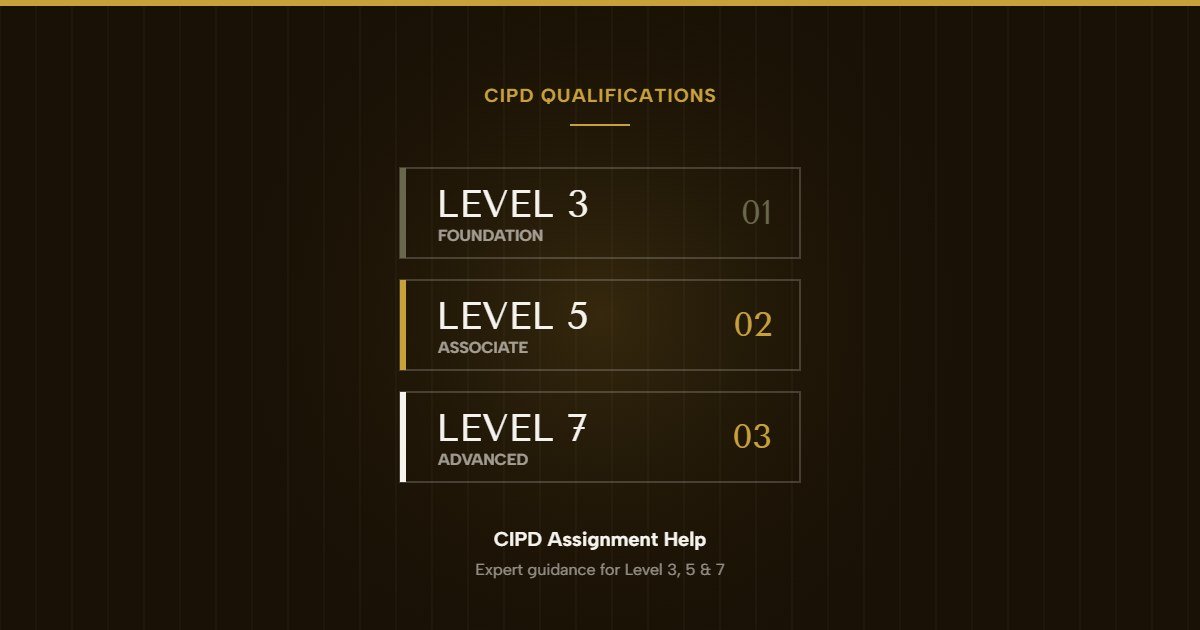
The CIPD pathway takes learners from foundational knowledge to strategic leadership. Assessment becomes more rigorous at each level, building critical thinking, research, reflection and analytical skill.
CIPD Level 3
Core HR principles: recruitment and selection, employee relations, learning and development, employment law basics and HR administration. No strict entry requirements. Level 3 help
CIPD Level 5
HR advisory skills, operational management and evidence-based practice for advisory and operational roles. Level 5 help
CIPD Level 7
Strategic HR, leadership, organisational development and business strategy for senior roles. Level 7 help
| Qualification | Typical roles | Experience | Responsibilities | Career growth |
|---|---|---|---|---|
| CIPD Level 3 | HR Assistant, HR Administrator | Entry level | Recruitment support, HR administration, employee records | HR Coordinator |
| CIPD Level 5 | HR Advisor, HR Officer, People Advisor | 2 to 5 years | Employee relations, policy implementation, performance management | HR Manager |
| CIPD Level 7 | HR Business Partner, HR Manager, Head of HR | 5+ years | Strategic planning, leadership, organisational development | HR Director / Chief People Officer |
An HR Administrator might complete Level 3 to strengthen core HR knowledge, move to Level 5 as they begin advising managers, and later take Level 7 to become an HR Business Partner. For a full walkthrough of each level, read From Foundation to Strategic Thinking: Navigating the CIPD Learning Journey.
05How expectations change between Level 3, 5 and 7
As you progress, each level demands a deeper understanding of HR concepts, stronger critical thinking and greater workplace application.
| Criteria | Level 3 | Level 5 | Level 7 |
|---|---|---|---|
| Research | Basic | Intermediate | Advanced |
| Critical thinking | Limited | Analytical | Critical evaluation |
| Reflection | Simple | Detailed | Strategic |
| HR models | Core concepts | Applied models | Advanced frameworks |
| Workplace application | Basic examples | Operational decisions | Strategic business impact |
| Leadership thinking | Limited | Team leadership | Organisational leadership |
Common mistakes when choosing a level
- Choosing by perceived difficulty instead of career goals
- Expecting Level 5 to feel like Level 3
- Underestimating professional experience and reflective practice, both key to higher grades
06The modern HR professional: people, performance and purpose
Modern HR goes far beyond recruitment and payroll. HR professionals now play a strategic role in creating productive workplaces while supporting wellbeing and organisational success.
Key priorities
Successful HR professionals balance business objectives with employee needs. Different industries apply these principles in different ways:
| Industry | HR focus |
|---|---|
| Manufacturing | Improving workforce safety and reducing staff turnover |
| Healthcare | Managing employee wellbeing and workforce shortages |
| Retail | Enhancing customer service through employee engagement |
| Technology | Attracting and retaining highly skilled professionals |
| Public sector | Promoting equality, compliance and workforce planning |
07Why HRM has become a strategic business function
HR has evolved from an administrative department into a strategic business partner, because organisations now see their people as a source of long-term competitive advantage. Modern HR contributes to business strategy, workforce planning, organisational culture, performance and risk management, succession planning and people analytics.
Several recognised frameworks help HR professionals improve organisational performance:
Ulrich HR Model
Positions HR as strategic partner, employee champion, change agent and administrative expert.
Harvard HR Model
Emphasises stakeholder interests, employee commitment and long-term organisational success.
AMO Framework
Performance improves when employees have the Ability, Motivation and Opportunity to contribute.
CIPD Profession Map
A roadmap of the behaviours, knowledge and skills needed throughout an HR career.
Each framework has its own strengths, and organisations often combine them to meet changing business needs.
08Skills every future HR professional should develop
09Common mistakes across the CIPD journey
| Mistake | Impact | Best practice |
|---|---|---|
| Ignoring feedback | Repeated errors | Apply tutor recommendations |
| Weak referencing | Lower grades | Use accurate Harvard referencing |
| Poor planning | Missed deadlines | Create a writing schedule |
| Lack of reflection | Weak evaluation | Include reflective practice |
| Few workplace examples | Limited application | Link theory with practice |
| Poor research | Weak arguments | Use credible academic sources |
| Last-minute writing | Reduced quality | Start assignments early |
Expert recommendations
- Read CIPD publications regularly
- Stay up to date with employment legislation
- Use peer-reviewed research in assignments
- Apply HR theories to workplace situations
- Reflect on your professional experience
- Strengthen critical thinking and analysis
- Seek constructive feedback and keep improving your writing
Trusted resources: the CIPD Profession Map and Factsheets, ACAS guidance, UK Government employment guidance, Harvard Business Review, the Academy of Management Journal, Human Resource Management Journal, the International Labour Organization (ILO) and the Chartered Management Institute (CMI).
Success in a CIPD qualification takes more than HR experience. Strong academic writing, evidence-based decisions, critical thinking and reflection are what earn high grades.
Key takeawayFAQFrequently asked questions
Is a CIPD qualification worth it?
Yes. It improves professional credibility and supports career progression.
Which CIPD level should I choose?
Choose the level that matches your qualifications, experience and career goals.
Is CIPD Level 5 difficult?
It is more analytical than Level 3 and requires stronger academic writing skills.
What is critical analysis?
Evaluating evidence, comparing viewpoints and justifying your conclusions.
Can workplace experience replace academic references?
No. Practical experience should support academic evidence, not replace it.
How many references should a CIPD assignment include?
It varies, but quality and relevance matter more than quantity.
What is evidence-based practice?
Making HR decisions using research, organisational data and professional expertise.
Do employers value CIPD qualifications?
Yes. Many employers see a CIPD qualification as an important indicator of HR competence.
Ready to move from Pass to Distinction?
Whether you are starting Level 3 or completing Level 7, our HR and CIPD specialists help you understand the brief, structure your work and apply HR theory with confidence.
Keep reading
This guide supports independent learning. Always follow your centre’s assessment brief and academic integrity policy, and submit only work that reflects your own understanding.


Leave a Reply